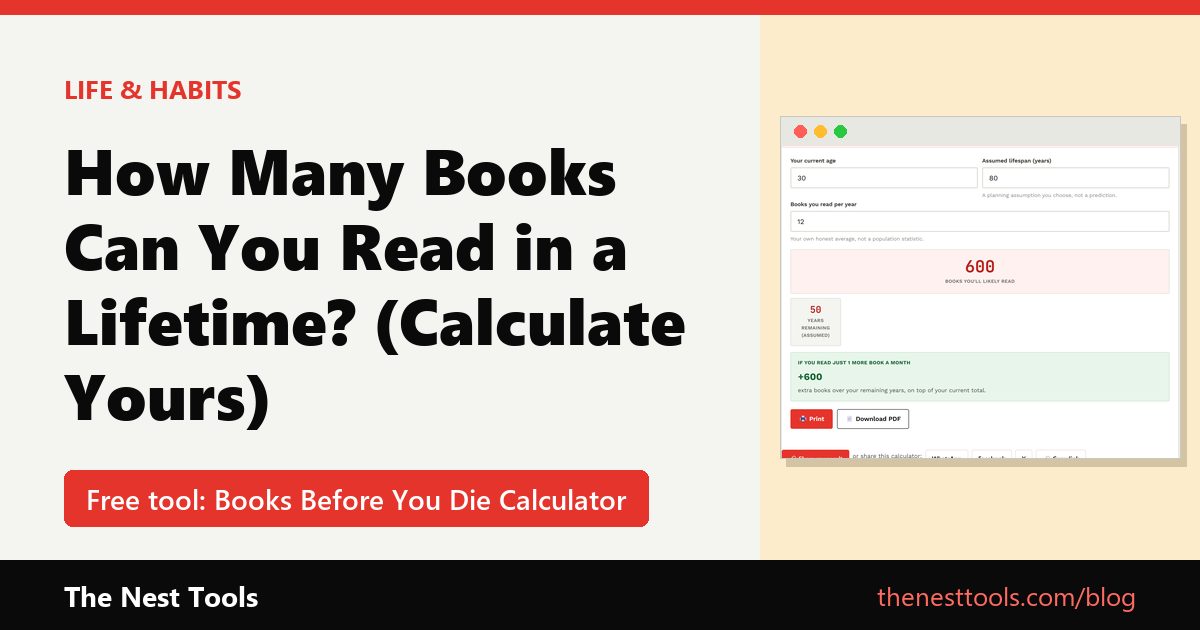
If you read five books a year and you’re 30 today, you have roughly 250 books left in you. Not 250 a decade. Two hundred and fifty, total, for the rest of your life, assuming you live to 80 and your habits don’t change. For a lot of people that number lands somewhere between sobering and genuinely motivating.
Here’s how to work out your own number, what “average” really means for readers, and the one variable that changes the answer more than anything else.
The Simple Formula
The math is short enough to do on a napkin:
Books left = (life expectancy − current age) × books you read per year
That’s it. The hard part isn’t the arithmetic, it’s being honest about the inputs. Most people overestimate how much they read (last year’s “about 20” is often closer to 8 once you actually count), and nearly everyone underestimates how much a small daily habit adds up over decades.
Our Books Before You Die Calculator does this for you: enter your age, an assumed lifespan and your yearly reading pace, and it shows the total instantly, so you can play with the numbers without redoing the math each time.
How Many Books Does the Average Person Read?
The most-cited figures come from Pew Research Center’s surveys of American adults. In its early-2021 survey, the typical (median) American read five books in the previous 12 months, while the average (mean) was about 14. Those two numbers were identical to Pew’s first survey in 2011, so reading habits have been remarkably stable for over a decade. Pew also found that roughly a quarter of adults (23%) hadn’t read a single book, in whole or in part, in the past year.
The gap between the median (5) and the mean (14) tells you something important: a relatively small group of heavy readers pulls the average up. Most people read a handful of books a year, and a minority read dozens.
Books Left in a Lifetime, by Reading Pace
Here’s what the formula gives for someone who is 30 today with a life expectancy of 80, which leaves 50 reading years:
| Reading pace | Books per year | Books left (50 years) |
|---|---|---|
| Median American reader | 5 | 250 |
| One a month | 12 | 600 |
| Average (mean) American reader | 14 | 700 |
| Two a month | 24 | 1,200 |
| One a week | 52 | 2,600 |
The one-a-week figure lines up with a well-known sketch by Sketchplanations, which estimated around 3,500 books for a dedicated reader over about 70 reading years. The shape is the same at every level: your total is only ever your pace multiplied by your remaining years, so changing the pace is the only lever you actually control.
How Long Does It Take to Read a Book?
“Books per year” feels abstract, so it helps to translate it into minutes per day.
A large 2019 meta-analysis by psychologist Marc Brysbaert, covering 190 studies and nearly 18,600 readers, found that adults silently read English at about 238 words per minute for non-fiction and 260 for fiction, noticeably slower than the often-quoted 300. A typical adult novel runs somewhere around 70,000 to 100,000 words. Take 90,000 words at 260 words per minute and you get roughly 346 minutes, or just under six hours of reading per novel.
That turns into a surprisingly practical table:
| Daily reading time | Hours per year | ≈ Novels per year |
|---|---|---|
| 10 minutes | 61 | 10 |
| 20 minutes | 122 | 21 |
| 30 minutes | 183 | 31 |
| 60 minutes | 365 | 63 |
In other words, 20 minutes a day is enough to read more than four times as many books as the median American. You don’t need to become a “reader” as an identity. You need a slot in the day that’s reliably yours: a commute, the first 20 minutes in bed, lunch breaks.
What Changes the Number Most
Pace beats lifespan. Adding five years to your life expectancy adds five years of reading. Going from 5 books a year to 12 more than doubles your total. If you’re trying to change the answer, look at the daily habit, not the life-expectancy input.
Starting age matters less than you’d think. A 50-year-old who moves from 5 to 25 books a year will read more over the next 30 years (750) than a 30-year-old who stays at 5 for 50 years (250).
Book length is a quiet factor. A year of long histories and a year of short novels can differ by 2x in page count. If you care about the number, track time spent reading rather than titles finished.
Audiobooks count. Pew’s surveys count books read “in whole or in part” in any format, and listening during a commute or workout is the easiest way to add reading time without taking it from anything else.
Using Your Number Well
A finite list changes how you choose. If you have 600 books left, finishing a book you’re not enjoying costs you one of them. A few habits that follow naturally:
- Quit books early. Give a book 50 pages or 10% and move on without guilt if it isn’t working.
- Keep a short “must read” list. Ten titles you’d genuinely regret missing, reviewed once a year.
- Re-read on purpose. A favorite book reread at 25 and at 50 is effectively two different books.
- Protect one daily slot. Twenty minutes, same time, every day, is what actually moves the total.
Frequently Asked Questions
How many books can the average person read in a lifetime?
At the median American pace of five books a year, an adult with 50 reading years ahead of them will read about 250 more books. At the mean of about 14 a year it’s roughly 700. A one-book-a-week reader gets to around 2,600 over the same period.
How many books do you need to read a year to be above average?
More than five puts you above the typical (median) American reader, according to Pew Research Center. Reading 14 or more a year puts you above the mean.
How long does it take to read an average book?
At about 260 words per minute for fiction, a 90,000-word novel takes just under six hours. Non-fiction is read slightly slower, around 238 words per minute, so a book of the same length takes a little over six hours.
Is it realistic to read 50 books a year?
Yes. At roughly six hours per novel, 50 books is about 300 hours a year, which works out to around 50 minutes a day. Mixing in shorter books and audiobooks during commutes makes it easier.
Want to see your own number? Enter your age and reading pace in the Books Before You Die Calculator. It takes about ten seconds.
Sources: Pew Research Center (2022); Brysbaert, “How many words do we read per minute?” Journal of Memory and Language (2019); Sketchplanations.