On Pluto, nobody alive today has had a first birthday. Not the oldest person on Earth, not anyone. One trip around the Sun takes Pluto about 248 Earth years, so a 30-year-old is only about 0.12 of a Pluto year old. On Mercury, the same person just turned 124.
Here’s how “age on other planets” works, the quick formula to do it yourself, and a table for every planet (plus Pluto) so you can find your age without any math.
What Your “Age” on Another Planet Actually Means
A year is simply one full orbit around the Sun. Earth takes about 365.25 days. Planets closer to the Sun travel a shorter path and move faster, so their years are shorter. Planets farther out have enormous orbits and crawl along them, so their years are much longer.
Your age on another planet is just the number of that planet’s orbits that have happened since you were born. It has nothing to do with gravity or how fast you’d age biologically. It’s purely a different way of counting the same stretch of time.
The Formula
Age on a planet = your age in Earth days ÷ that planet’s orbital period in Earth days
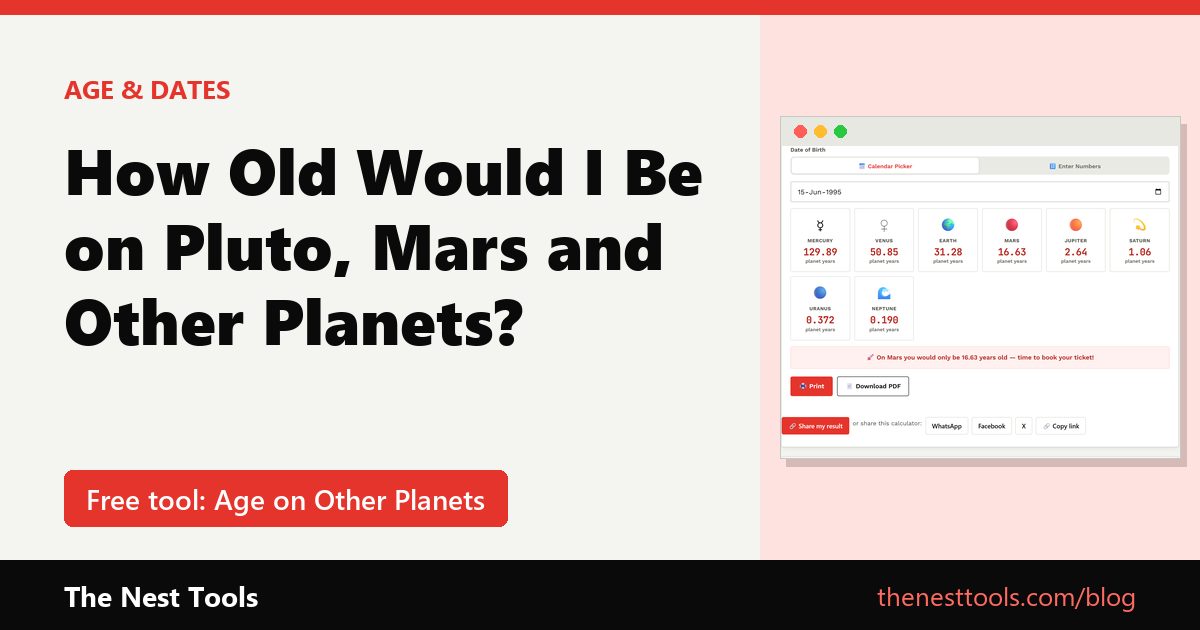
Or, more roughly: your age in Earth years ÷ the planet’s year length in Earth years. Our Age on Other Planets calculator does it from your exact date of birth for all eight planets, so leap years and the extra days since your last birthday are counted properly.
How Long a Year Is on Each Planet
| World | Orbital period (Earth days) | ≈ Earth years |
|---|---|---|
| Mercury | 87.97 | 0.24 |
| Venus | 224.70 | 0.62 |
| Earth | 365.25 | 1.00 |
| Mars | 686.98 | 1.88 |
| Jupiter | 4,332.59 | 11.86 |
| Saturn | 10,759.22 | 29.46 |
| Uranus | 30,688.5 | 84.02 |
| Neptune | 60,182 | 164.8 |
| Pluto (dwarf planet) | ≈ 90,560 | ≈ 248 |
Your Age on Every Planet at 10, 30 and 50
| World | Age 10 on Earth | Age 30 on Earth | Age 50 on Earth |
|---|---|---|---|
| Mercury | 41.5 | 124.6 | 207.6 |
| Venus | 16.3 | 48.8 | 81.3 |
| Mars | 5.3 | 16.0 | 26.6 |
| Jupiter | 0.84 | 2.5 | 4.2 |
| Saturn | 0.34 | 1.02 | 1.7 |
| Uranus | 0.12 | 0.36 | 0.60 |
| Neptune | 0.06 | 0.18 | 0.30 |
| Pluto | 0.04 | 0.12 | 0.20 |
How Old Would I Be on Pluto?
Divide your age in Earth years by about 248. A 30-year-old is 30 ÷ 248 ≈ 0.12 Pluto years old, meaning Pluto has travelled only about 44 degrees of its 360-degree orbit since they were born.
Pluto hasn’t even completed one orbit since humans discovered it. Clyde Tombaugh spotted it in February 1930, and it won’t return to that point in its orbit until around 2178. It was named by Venetia Burney, an 11-year-old girl in Oxford who suggested the name of the Roman god of the underworld. In 2006 the International Astronomical Union reclassified Pluto as a dwarf planet, which is why many planet-age calculators, including ours, stick to the eight planets and leave Pluto as a manual calculation.
How Old Would I Be on Mars?
A Mars year is 687 Earth days, just under two Earth years, so you roughly halve your age. Someone who is 30 on Earth is about 16 on Mars. Mars birthdays arrive about every 22½ months, which is why Mars mission teams track time in both Earth dates and Martian years.
How Old Would I Be on Mercury?
Mercury races around the Sun in 88 days, so you’d have a birthday roughly every three months. Multiply your Earth age by about 4.15. A 30-year-old is about 124 on Mercury, and a 10-year-old is already past 41.
How Old Would I Be on Neptune and Saturn?
Neptune’s year lasts nearly 165 Earth years, so no human will ever reach a first Neptune birthday. In fact, Neptune only completed its first full orbit since its 1846 discovery in 2011. Saturn’s 29.5-year orbit is more human-sized: most people see their first Saturn birthday around age 29 or 30 and a second around 59. (Astrologers call this the “Saturn return,” but the orbital timing itself is plain astronomy.)
A Fun Classroom or Party Activity
Planet ages are a favorite in science classrooms because they make orbital periods tangible. A few ways to use them:
- Find your next Mars birthday. Add 687 days to the date you were born, keep adding, and circle the one coming up next.
- Compare a family. Grandparents are often the only people at the table who have had a Saturn birthday.
- Plot it. Ask students to graph age against distance from the Sun; the curve shows Kepler’s third law without any equations.
Frequently Asked Questions
Why are you younger on outer planets?
Outer planets have much longer orbits and move more slowly, so their years are longer. Fewer of their years fit into your lifetime, which makes your age in their years smaller.
Would you actually age slower on another planet?
No. Your body ages at the same rate everywhere in the solar system for practical purposes. Planet ages are just a different unit for counting time, like measuring the same distance in miles instead of kilometres.
What planet would make you the oldest?
Mercury, because it has the shortest year of any planet at about 88 Earth days. Your Mercury age is roughly four times your Earth age.
Is anyone one year old on Neptune or Pluto?
No. A Neptune year is about 165 Earth years and a Pluto year about 248, both longer than any human lifespan.
Want your exact age on all eight planets from your birthday? Try the Age on Other Planets calculator.
Sources: orbital periods from NASA Planetary Fact Sheet; Exploratorium; Space Centre NZ.