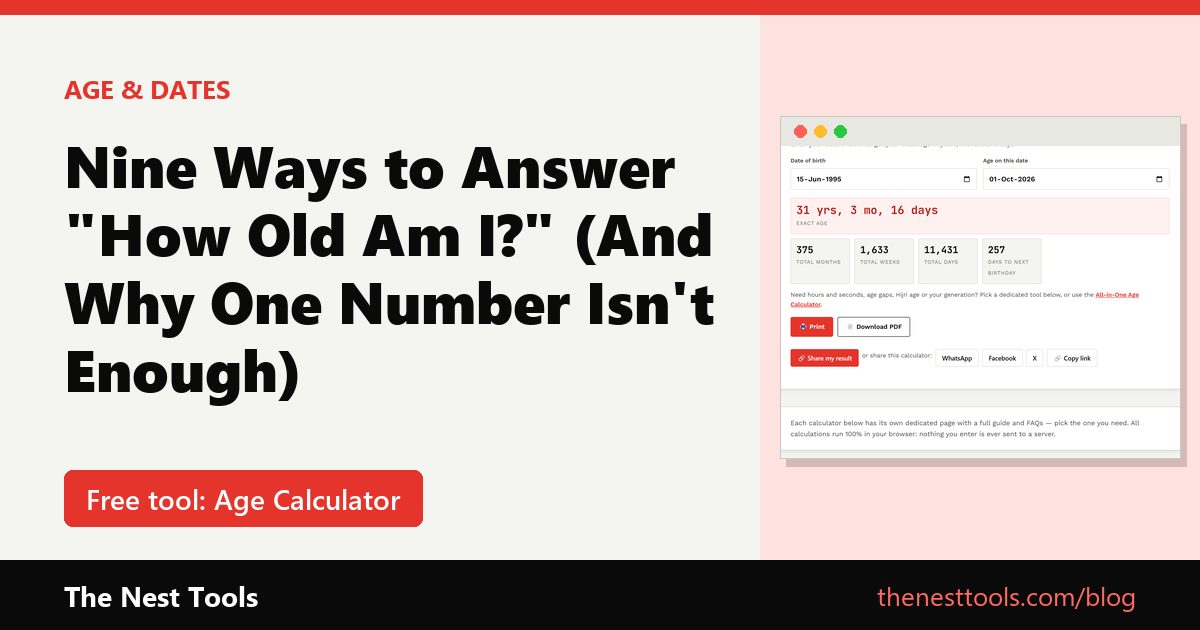
Ask someone their age and you get one number back. But that single date of birth you were born on can actually answer several different questions, depending on what you’re trying to find out.
The same input, different outputs
Take a date of birth, say January 1, 2000. From that one date alone you can work out: your exact age in years, months and days as of today; how many total days you’ve been alive; the exact gap between you and someone else’s birthday; how old you’ll be on a specific future date; what generation you were born into; your age converted to the Islamic Hijri calendar; and even, just for fun, how old you’d be if you measured age in Mars years instead of Earth years.
None of these are separate facts. They’re all the same underlying calculation, elapsed time between two dates, just framed differently depending on what you need the answer for.
Why “exact age” is trickier than it looks
The part people get wrong most often is leap years. If you were born on February 29, your “birthday” only occurs on the calendar every four years, but you still age by exactly one year every 365 or 366 days regardless. A correct age calculator has to count actual elapsed days and convert that into years and months, not just subtract year numbers, because subtracting years alone breaks the moment your birthday hasn’t happened yet this calendar year.
For example, someone born on June 15, 1995 isn’t 30 years old the entire year of 2025, only from June 15 onward. Before that date in 2025, they’re still 29. A quick year-subtraction (2025 minus 1995 = 30) gives the wrong answer for roughly half the calendar year.
Why splitting these into different tools actually helps
A generation calculator needs your birth year compared against fixed generational cutoffs (Gen Z, Millennial, and so on). A Hijri age calculator needs to convert a solar Gregorian date into the roughly 354-day lunar Hijri calendar, which drifts against the Gregorian calendar by about 11 days a year, so your Hijri age in years isn’t the same number as your Gregorian age. An age-gap calculator needs two dates of birth instead of one, and has to handle the case where the gap crosses a leap day differently depending on which person’s birthday comes first in the year.
Each of these has its own small set of edge cases worth getting right, which is why it’s usually clearer to use a tool built for the specific question you’re asking rather than trying to do the math backward from a single generic “age” result.
Picking the right one
If you just want your current exact age, a straightforward age calculator is enough. If you’re comparing two people’s ages, comparing dates, or want something specific like your Hijri age or your age on another planet, it’s worth using the calculator built for that exact question, since the underlying math changes each time.
Our Age Tools Hub collects all nine of these into one place, so you can jump between them without re-entering your date of birth each time.
Frequently Asked Questions
How do I calculate my exact age?
Count the full years since your date of birth, then the extra months and days since your last birthday. An age calculator does this automatically and handles leap years correctly.
Why is subtracting birth years not always accurate?
Because it ignores whether your birthday has happened yet this year. Someone born in June 1995 is 29, not 30, until June 15, 2025.
Why is my Hijri age higher than my Gregorian age?
The Islamic Hijri year is about 354 days, roughly 11 days shorter than a Gregorian year, so more Hijri years pass in the same lifetime.
[…] Nine Ways to Answer “How Old Am I?” (And Why One Number Isn’t Enough) […]