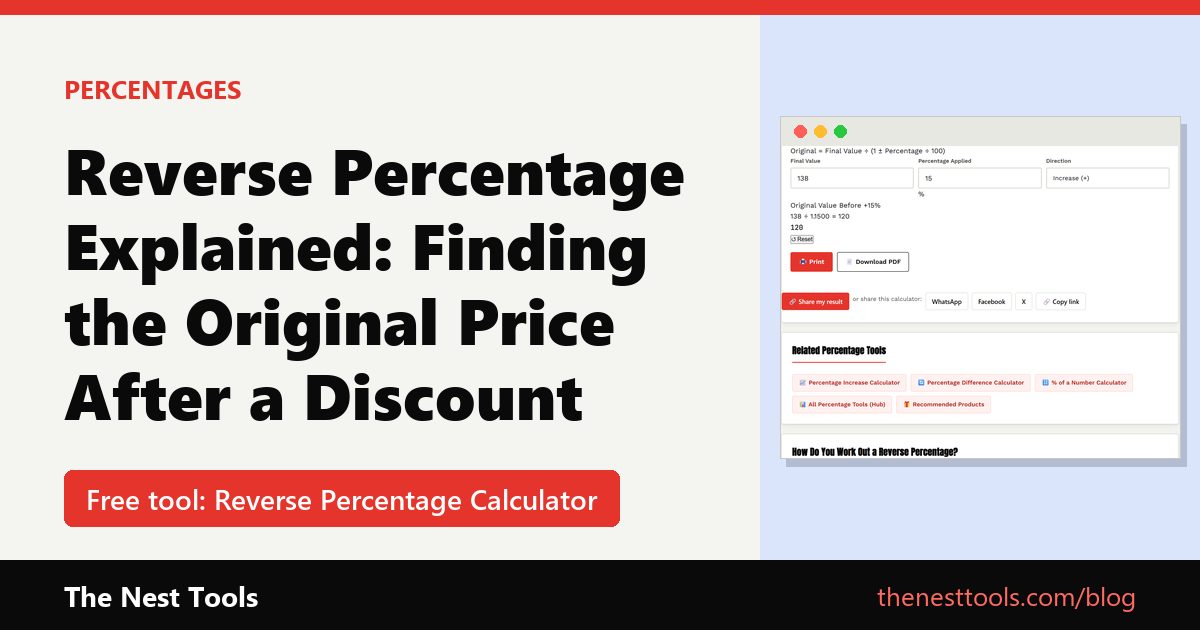
Most percentage questions go forward: you know the original number and the percentage, and you want the result. Reverse percentage flips that: you know the result, and you want to find the original number it came from.
The formula
To find an original value before a percentage decrease (like a discount) was applied:
Original = Result ÷ (1 − Percentage ÷ 100)
For a percentage increase (like tax added), subtract becomes add:
Original = Result ÷ (1 + Percentage ÷ 100)
Worked example: finding the price before a discount
You see a jacket on sale for $68, marked as “15% off.” What was it before the discount?
Original = $68 ÷ (1 − 0.15) = $68 ÷ 0.85 = $80
A common mistake here is calculating 15% of $68 and adding it back ($68 + $10.20 = $78.20), which is wrong, because 15% of the *original* price was removed, not 15% of the sale price. The two numbers are different because the discount percentage applies to a different base.
Worked example: finding the pre-tax price
A receipt shows a total of $53.50 including 7% sales tax. What was the price before tax?
Original = $53.50 ÷ (1 + 0.07) = $53.50 ÷ 1.07 = $50.00
Why this comes up more than you’d think
Beyond shopping, this same math shows up in payroll (working out gross pay from a net figure after a known deduction rate), business pricing (reverse-engineering a cost basis from a marked-up retail price), and comparing sales across stores where only the final price is shown.
Our Reverse Percentage Calculator does this calculation instantly for both the discount and tax-inclusive cases above.
Frequently Asked Questions
How do you find the original price after a discount?
Divide the sale price by (1 − discount rate). A $68 item marked 15% off was originally $68 ÷ 0.85 = $80.
How do you remove sales tax from a total?
Divide the total by (1 + tax rate). A $53.50 total with 7% sales tax was $53.50 ÷ 1.07 = $50.00 before tax.
Why can’t I just add the discount percentage back on?
Because the discount was a percentage of the original price, not the sale price. Adding 15% of $68 gives $78.20, which undershoots the true original of $80.