A store advertises 20% off, you have a 10% coupon, and it’s easy to assume you’re getting 30% off the original price. You’re not. Here’s the actual math, and why the real number is always a bit less than the sum of the two percentages.
Why 20% + 10% Doesn’t Equal 30% Off
Discounts stack multiplicatively, not additively. The second discount applies to the already-reduced price from the first one, not to the original price. On a $100 item: 20% off brings it to $80. Take another 10% off that $80, not the original $100, and you get $72. Your total savings is $28 on a $100 item, a 28% effective discount, not 30%.
The gap between the two numbers grows as the discounts get bigger. Two 25% discounts stacked don’t make 50% off, they make 43.75% off: $100 becomes $75 after the first discount, then $56.25 after the second, a combined savings of $43.75, not $50.
A Bigger Example
Take a $120 item with a 30% storewide sale plus an extra 15% coupon on top. 30% off $120 is $84. Take 15% off that $84, and you land at $71.40. Total savings: $48.60, an effective discount of 40.5%, meaningfully less than the 45% a straight sum would suggest, though still a substantial saving.
Why This Matters When You’re Actually Shopping
Retailers aren’t hiding anything shady here, multiplicative stacking is just how percentage discounts mathematically compound, the same underlying math as compound interest, just working in your favor as a shopper instead of against you as a borrower. The practical issue is that most people mentally add percentages together out of habit, which means the number in your head going into checkout is usually a little higher than what you’ll actually see subtracted.
This matters most when you’re comparing two different stacking offers against each other. “20% off plus an extra 10%” and “flat 28% off” sound like different deals, one sounds bigger, but they’re mathematically identical. Knowing this stops you from picking a worse-sounding but actually-equal or better flat discount over a stacked one that sounds bigger.
Calculate Your Real Effective Discount
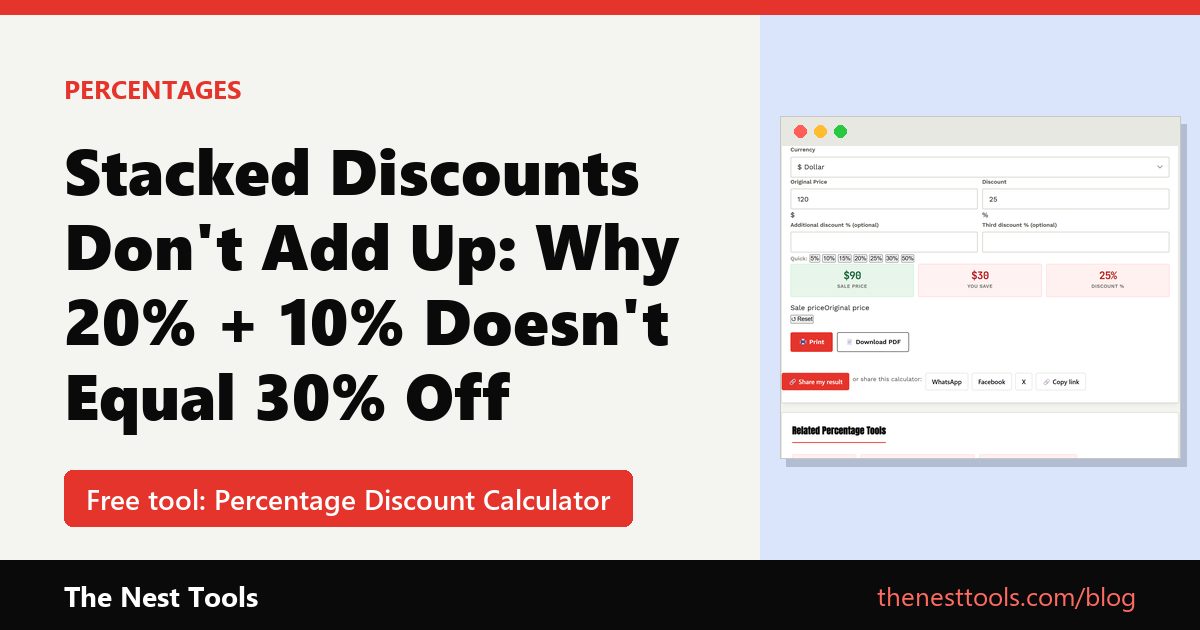
Rather than multiplying percentages by hand or guessing, our Discount Calculator has a dedicated mode for exactly this: enter up to three stacked discounts, and it calculates your true effective percentage automatically, along with a plain-language note like “your effective discount is 28%, not 30%” whenever the stacked total differs from what a naive sum would suggest.
If you’re trying to figure out the reverse, what a price was before a discount was applied, our Reverse Percentage Calculator handles that specific direction instead.
Frequently Asked Questions
Do discounts add up when you stack them?
No. Stacked discounts multiply against the already-reduced price, not the original price, so the combined discount is always slightly less than the sum of the individual percentages. 20% plus 10% comes to 28% off, not 30%.
How do I calculate a double discount?
Apply the first discount to the original price, then apply the second discount to that new, already-reduced price, not the original. Or use a discount calculator that supports multiple stacked discounts directly.
What is coupon stacking math, exactly?
It’s the same multiplicative principle applied to any number of successive percentage reductions, a storewide sale plus a coupon plus a loyalty discount, for example. Each additional discount applies to the price left after the previous one, so the effective total discount is always a bit below the simple sum of all the percentages involved.
What’s the effective discount percentage for two stacked discounts?
It depends on the two rates, but it’s always less than their sum. For two discounts of a% and b%, the combined discount works out to a + b − (a×b/100) percent. For 20% and 10%, that’s 20 + 10 − 2 = 28%.
See your real effective discount instantly, for one discount or several stacked together, with the Discount Calculator.
[…] Stacked Discounts Don’t Add Up: Why 20% + 10% Doesn’t Equal 30% Off […]