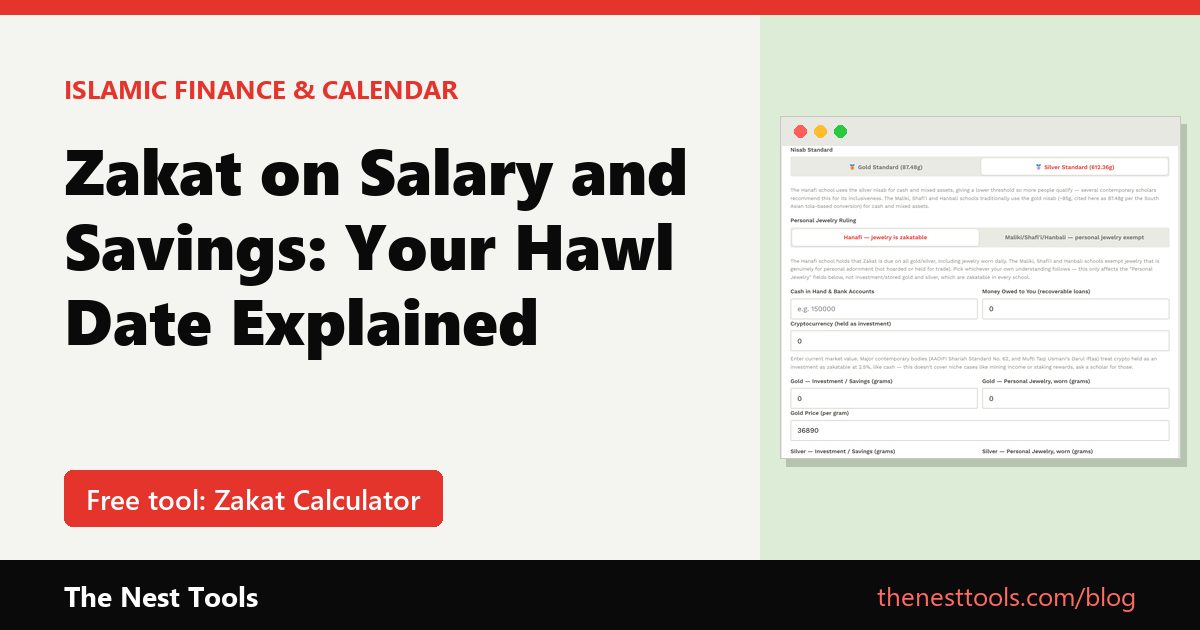
Zakat isn’t due on your salary when you’re paid; it’s due on what you’ve saved. Once your savings and other zakatable wealth reach nisab, a lunar year (hawl) starts. On the same Islamic date a year later, you pay 2.5% of the zakatable wealth you hold that day, provided it’s still at or above nisab. If you don’t know when you first reached nisab, pick a date and keep to it every year.
This guide explains the hawl, how salary fits in, what the schools say when savings dip below nisab during the year, and a worked example.
Salary vs Savings
Wages are income, not zakatable wealth in themselves. The money you spend on rent, food and bills during the month never becomes subject to zakat. What matters is the wealth you hold on your zakat date: cash, bank balances, savings, gold and silver, investments held for growth, business stock and money you’re owed that you expect to receive, less debts that are due now.
What the Hawl Is
- The hawl is one lunar year, about 354 or 355 days, about 11 days shorter than a calendar year.
- It starts on the day your zakatable wealth first reaches nisab.
- Your zakat date is the same Islamic date each year, for example 1 Ramadan or 10 Muharram.
- You don’t need a separate hawl for each month’s savings. On your zakat date you add up everything you own that’s zakatable and pay 2.5% of the total, including money saved only recently.
Don’t know your start date? Many people don’t. Choose a memorable Islamic date and use it consistently every year. Because the lunar year is shorter, a Gregorian date such as 1 January would put about 11 days more between payments each year, so a lunar date is the usual advice.
What If Savings Dip Below Nisab During the Year?
Here the schools differ:
| School | If wealth falls below nisab mid-year |
|---|---|
| Hanafi | The hawl continues. What counts is having at least nisab at the start and on the zakat date; dips in between are overlooked, unless the wealth is lost entirely. |
| Maliki, Shafi’i, Hanbali | The hawl restarts. It begins again from the day the wealth climbs back to nisab. |
For most salaried people who build savings steadily, the result is the same. The difference matters when a large expense, such as a wedding or a house deposit, briefly empties your savings in the middle of the year.
Worked Example
Aisha’s zakat date is 1 Ramadan. She’s paid monthly and saves part of each salary.
- On 1 Ramadan she adds up: bank savings 8,200, cash at home 300, and gold she keeps as savings worth 1,500. Total = 10,000.
- She has a credit card bill of 400 due now: 10,000 − 400 = 9,600.
- That’s above nisab, and she’s held nisab since last 1 Ramadan, so zakat = 9,600 × 2.5% = 240.
Money she saved only last month is included, because it’s part of her wealth on the zakat date. Her salary from earlier in the year, which she spent, isn’t.
Common Questions to Settle First
- Nisab standard: gold (about 85–87.48 g) or silver (about 595–612.36 g). The silver standard is lower, so more people owe zakat under it. See gold standard vs silver standard.
- Retirement and pension funds: scholars differ on whether, and when, funds you can’t yet access are zakatable. Ask a scholar you trust about your specific scheme.
- Debts: commonly only amounts due now are deducted, not the full balance of a long-term loan. Views on long-term debts vary.
Frequently Asked Questions
Do I pay zakat on my monthly salary?
Not when you receive it. Zakat is due on the wealth you still hold on your zakat date, once it’s at or above nisab and a lunar year has passed since you first reached nisab. Salary you’ve already spent is not counted.
Does each month’s savings need its own year?
No. Once your hawl has started, you pay on everything zakatable you own on your zakat date, including money saved recently. Keeping a separate year for each deposit isn’t necessary and would make zakat very hard to calculate.
What happens if my savings fall below nisab during the year?
Under the Hanafi school, the year continues if you had nisab at the start and have it on your zakat date. Under the Maliki, Shafi’i and Hanbali schools, the year restarts from when your wealth reaches nisab again.
Can I pay zakat monthly instead of once a year?
Many scholars allow paying zakat in advance in instalments during the year, as long as you settle the full amount due on your zakat date. Calculate the total on your date, subtract what you’ve already paid, and pay the balance.
Add up your savings, gold, silver and debts in the free zakat calculator, and find the Gregorian date of your Islamic zakat date with the converter in the Hijri age calculator.
Sources: positions of the schools on the hawl as summarised by Joe Bradford, “The hawl” and National Zakat Foundation. This guide explains common positions and is not a fatwa.