Cut out one $5 latte a day, invest the savings, and retire a millionaire. It’s one of the most repeated pieces of financial advice of the last 25 years, and it has a name: the Latte Factor. It’s also, according to the people who’ve actually run the numbers, not really true.
Here’s where the idea came from, what the math actually says, and how to use it without falling for the part that doesn’t hold up.
Where the Latte Factor Came From
The term belongs to financial author David Bach, who first raised the idea in his 1999 book Smart Women Finish Rich, then built an entire later book around it: The Latte Factor (2019). The pitch was simple and appealing: most people have some small, forgettable daily expense, a coffee, a snack, a soda, that quietly adds up to real money over a career. Redirect it into investments instead, and compounding does the rest.
Bach’s version used a $5-a-day habit (originally a latte, padded out with a biscotti and the odd soda, according to critics who’ve traced his math back to the original book), invested at what he assumed would be a 10-11% average annual return. Run that forward to retirement age, he argued, and you’d end up with over a million dollars from a habit you’d barely notice giving up.
Why Financial Writers Pushed Back
The math is the part that didn’t survive scrutiny. Journalist Helaine Olen, who covered the Latte Factor in her book Pound Foolish, pointed out the two assumptions doing all the work: an inflated daily spend, and an investment return well above what the market has actually delivered. The Dow Jones’ real average annual return between 1929 and 2009 was closer to 9%, not 10-11%, and that’s before accounting for inflation, taxes, and fund fees, all of which quietly eat into a real portfolio’s growth.
When the personal-finance blog Bad Money Advice reran Bach’s own numbers with more realistic assumptions, the result wasn’t “over a million dollars.” It landed around $173,000, still a meaningful sum from a small daily habit, but nowhere near the number that made the original pitch so viral.
None of this means the underlying idea is worthless. Small recurring costs genuinely do add up, and seeing the real multi-year total of a daily habit is a legitimately useful gut check. The problem was never “does a daily expense add up over time,” it obviously does. The problem was the investment return assumption doing more work in the story than it could actually do in a real brokerage account.
How Much Does a Daily Coffee Habit Actually Cost?
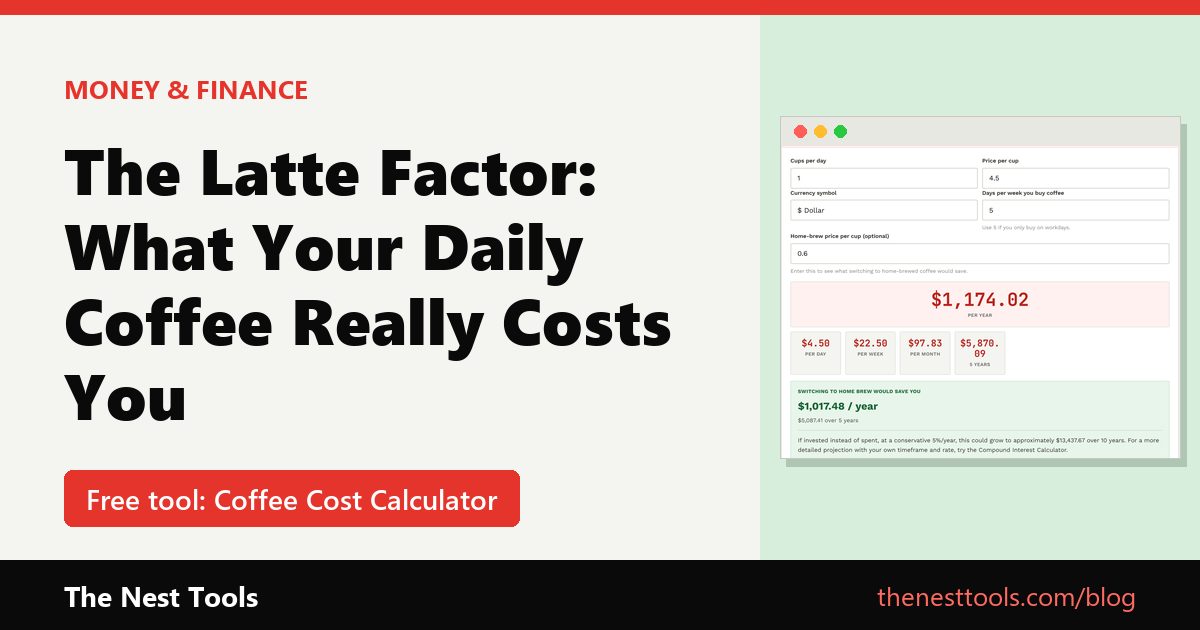
Take the math out of theory and put your own numbers in. Our Coffee Cost Calculator shows your real daily habit’s cost projected out to weekly, monthly, yearly, and five-year totals, along with what it could grow to if invested instead. We deliberately use a conservative 5% illustrative annual return, not Bach’s original 10-11%, specifically because of the criticism above: a number you can actually treat as a rough, real-world estimate rather than a best-case pitch.
The calculator also states plainly what every investment projection should: this is illustrative, not a guarantee, and actual returns can go down as well as up.
What If You Want to Run Your Own Numbers?
The Latte Factor is really a recurring monthly contribution, not a single lump sum, so the most accurate way to model it is our SIP Calculator: put in your redirected monthly amount, an assumed return, and a time period, and it projects the running total the same way a real recurring investment plan would. If you’d rather test a one-time lump sum instead, like investing a full year’s coffee savings at once, the Compound Interest Calculator is built for that specific case. Running the same habit at 5% versus 9% versus Bach’s original 11% side by side, in either tool, is a fast way to see exactly why the original claim generated so much pushback.
And if coffee isn’t your particular habit, the same logic applies to any small recurring cost. Streaming, apps, and subscriptions are the other classic example, worth a quick check with our Subscription Cost Calculator if you suspect they’ve quietly added up. Once you know your real number, the Savings Goal Calculator can help turn it into an actual monthly savings target instead of a vague intention.
Frequently Asked Questions
What is the Latte Factor?
It’s a personal finance concept popularized by author David Bach, describing how small, frequent daily purchases, like a coffee, can add up to a large amount of money over time, especially if the money saved is invested instead of spent.
Is the Latte Factor real, or debunked?
The core observation, that small recurring costs add up over time, is real and easy to verify with basic math. The specific claim that cutting a daily coffee habit will make you a millionaire has been widely criticized for relying on an inflated daily spending estimate and an unrealistically high assumed investment return (10-11%, versus the market’s actual long-run average closer to 9% before inflation, taxes, and fees).
How much does a daily coffee habit actually cost per year?
It depends entirely on what you’re actually spending, a $3 daily coffee comes to roughly $1,095 a year, while a $6 specialty drink comes to roughly $2,190. Use the Coffee Cost Calculator with your own price and frequency for an exact figure.
What if I invested my coffee money instead of spending it?
The honest answer depends heavily on the assumed rate of return, which is exactly where the original Latte Factor claim ran into trouble. At a conservative, realistic rate, the total is still meaningful over 5-10 years, just far short of the “millionaire” framing that made the idea famous. Try your own numbers in the calculator above to see a realistic projection rather than a best-case one.
Curious what your own coffee habit adds up to, with an honest investment estimate instead of an inflated one? Try the Coffee Cost Calculator.