Whether you’re looking at a home loan, car loan, or personal loan, your EMI (Equated Monthly Installment) is the fixed amount you’ll pay every month until the loan is repaid. Understanding how it’s calculated helps you see exactly where your money is going — and how changing the loan term or interest rate affects your monthly payment.
The Three Inputs That Determine EMI
- Principal (P) — the total loan amount you’re borrowing
- Interest rate (R) — the annual interest rate, converted to a monthly rate
- Tenure (N) — the total number of monthly installments
The EMI Formula
EMI = [P × R × (1+R)N] ÷ [(1+R)N − 1]
Where R is the monthly interest rate (annual rate ÷ 12 ÷ 100), and N is the number of months.
A Worked Example
Say you borrow $20,000 at 10% annual interest for 5 years (60 months):
- P = 20,000
- R = 10 ÷ 12 ÷ 100 = 0.00833
- N = 60
Plugging these into the formula gives an EMI of roughly $425/month, meaning you’ll pay about $25,500 in total over the loan — $5,500 of which is interest.
Why Two Loans With the Same EMI Can Cost Very Differently
A longer tenure lowers your monthly EMI but increases the total interest paid over the life of the loan. A shorter tenure raises the EMI but reduces total interest. This tradeoff is often the most important decision in loan planning — not just “can I afford the monthly payment,” but “how much am I paying in total.”
What an Amortization Schedule Shows You
Early in a loan, a larger portion of each EMI goes toward interest, and a smaller portion toward the principal. As the loan progresses, that ratio flips. An amortization schedule breaks this down month by month (or year by year), showing exactly how much of each payment reduces your actual debt.
How EMI Is Calculated on a Personal Loan (Example)
Take a personal loan of 10,000 at 12% a year, repaid over 3 years (36 months):
- Monthly rate: 12% ÷ 12 = 1% = 0.01.
- Number of payments: 3 × 12 = 36.
- EMI = 10,000 × 0.01 × (1.01)36 ÷ ((1.01)36 − 1) = 332.14 a month.
- Total paid: 332.14 × 36 = 11,957, so the interest is about 1,957.
In the first month, 100.00 of the payment is interest (1% of 10,000) and 232.14 reduces the balance. Each month the interest share falls and the principal share rises.
Watch for flat-rate quotes: some personal loans quote a “flat” 12%, charging interest on the full amount for the whole term. That makes the monthly payment 377.78 and total interest 3,600, almost double. Always ask whether the rate is reducing balance or flat; see flat rate vs reducing balance.
How EMI Is Calculated on a Car Loan (Example)
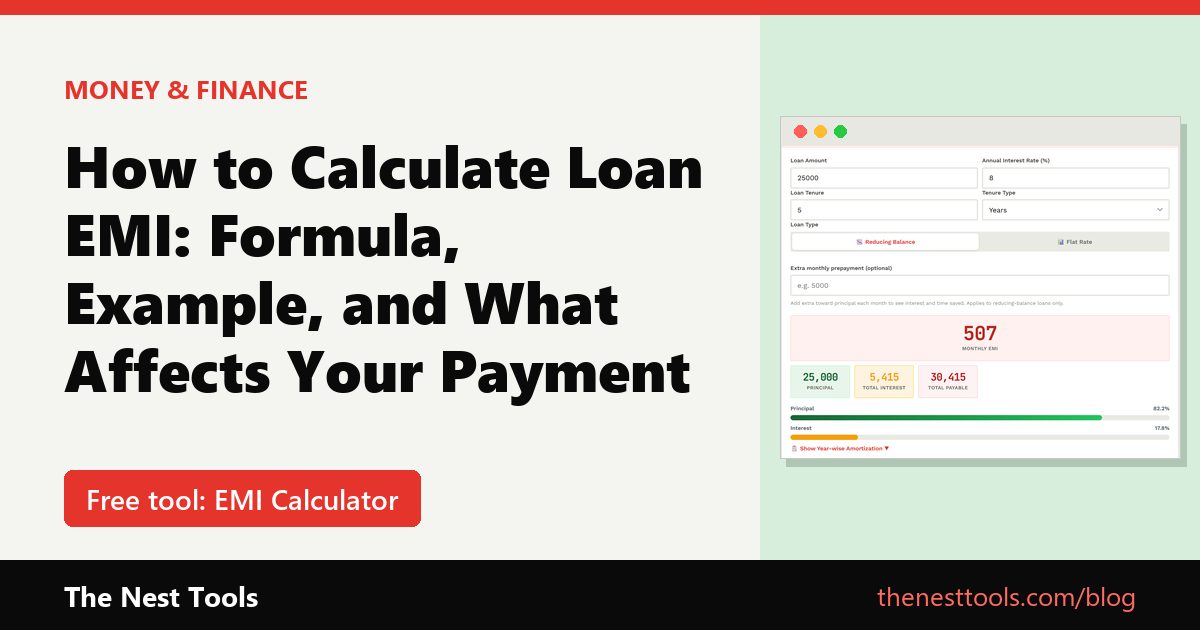
A car loan of 25,000 at 8% a year for 5 years (60 months):
- Monthly rate: 8% ÷ 12 = 0.6667% = 0.006667.
- Payments: 60.
- EMI = 25,000 × 0.006667 × (1.006667)60 ÷ ((1.006667)60 − 1) = 506.91 a month.
- Total paid: about 30,415, so interest is about 5,415.
A bigger down payment reduces the loan amount and every EMI; a shorter term raises the EMI but cuts total interest. More in how much interest you pay on a car loan.
| Loan | Amount | Rate | Term | EMI | Total interest |
|---|---|---|---|---|---|
| Personal loan | 10,000 | 12% | 3 years | 332.14 | 1,957 |
| Car loan | 25,000 | 8% | 5 years | 506.91 | 5,415 |
Calculate Your EMI Instantly
Instead of solving the formula by hand, The Nest Tools’ EMI Calculator gives you your exact monthly payment along with a full year-wise amortization schedule, so you can see the principal-vs-interest breakdown for the entire loan term.
Before committing to a loan, it is worth checking how the EMI actually fits into your monthly budget with our Budget Planner.
Frequently Asked Questions
Does a lower EMI always mean a better loan?
Not necessarily. A lower EMI from a longer tenure usually means paying more total interest over the life of the loan.
Does making an extra payment reduce my EMI?
Usually a lump-sum prepayment reduces your outstanding principal, which either shortens your tenure or lowers future EMIs, depending on what your lender allows.
Is the interest rate used in EMI calculations always fixed?
No — loans can have fixed or floating (variable) interest rates. EMI calculations assuming a fixed rate won’t be exact for a floating-rate loan, since the rate (and therefore the EMI) can change over time.