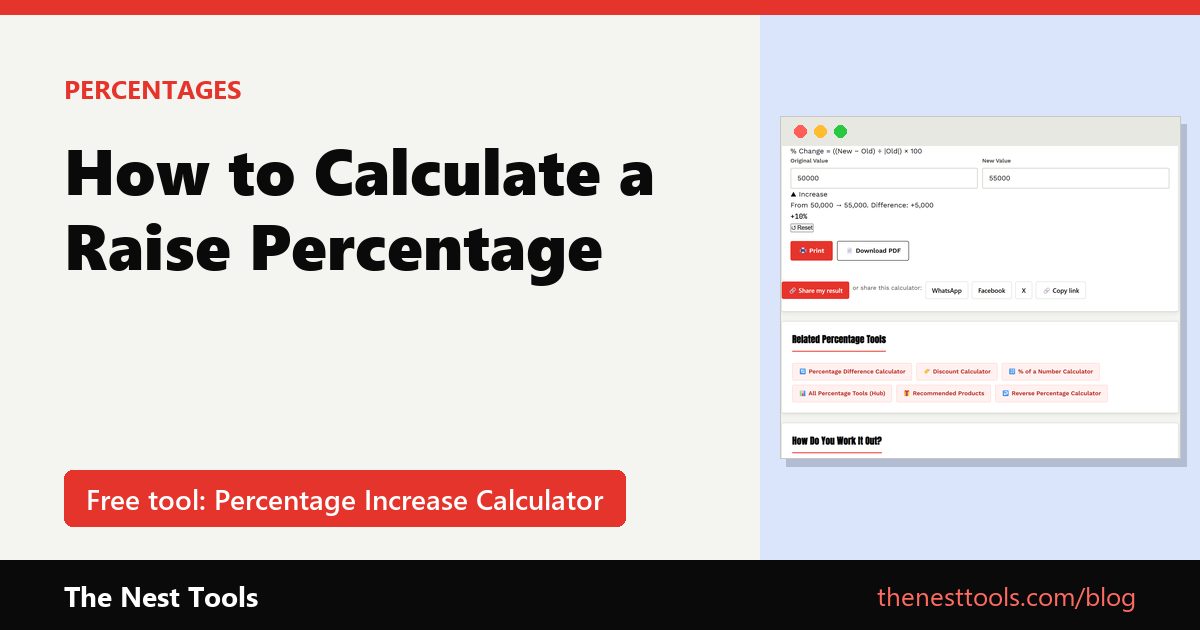
To calculate a raise percentage, subtract your old salary from your new salary, divide by the old salary and multiply by 100: from $52,000 to $55,640 is $3,640 ÷ $52,000 × 100 = 7%. The same works for hourly pay: $20 to $21.50 is a 7.5% raise. To find your new salary from a raise percentage, multiply: $52,000 × 1.07 = $55,640.
The Raise Formulas
| You know | You want | Formula |
|---|---|---|
| Old and new pay | Raise % | (New − Old) ÷ Old × 100 |
| Old pay and raise % | New pay | Old × (1 + raise ÷ 100) |
| New pay and raise % | Old pay | New ÷ (1 + raise ÷ 100) |
| Old pay and raise % | Raise amount | Old × raise ÷ 100 |
Enter any two salaries in the free Percentage Increase Calculator to get the exact raise percentage.
Examples
| Old pay | New pay | Raise | % |
|---|---|---|---|
| $45,000 a year | $46,800 | $1,800 | 4.0% |
| $60,000 a year | $63,000 | $3,000 | 5.0% |
| $75,000 a year | $82,500 | $7,500 | 10.0% |
| $18.00 an hour | $19.25 | $1.25 | 6.9% |
| $4,000 a month | $4,300 | $300 | 7.5% |
What a Raise Means Per Paycheck
A 5% raise on $60,000 is $3,000 a year before tax, which is $250 a month, about $115 per biweekly paycheck, or roughly $1.44 an hour. After tax, the take-home increase is smaller. Convert any salary between yearly, monthly, weekly and hourly with the Salary to Hourly Converter.
Is Your Raise Beating Inflation?
Your real raise is roughly your raise minus inflation. A 4% raise in a year with 3% inflation is only about a 1% gain in buying power; a 2% raise with 3% inflation is a pay cut in real terms. More precisely: real raise = (1 + raise) ÷ (1 + inflation) − 1. See is your raise beating inflation.
What Is a Typical Raise?
In the US, annual merit raises have typically averaged around 3% to 4% in recent years, with higher increases for promotions (often 10% or more) and job changes. A raise well above the average usually reflects a promotion, a market adjustment or strong performance. More in what is a good raise percentage.
Common Mistakes
- Dividing by the new salary: always divide by the old salary.
- Comparing gross with net: compare like with like, gross to gross or take-home to take-home.
- Adding raises together: two 5% raises in two years make 10.25%, not 10%.
- Ignoring hours: a higher salary with longer hours may be a smaller hourly raise.
Negotiating With the Numbers
Before a salary review, work out three numbers: your current pay, the inflation rate for the past year, and what similar roles pay in your area. If inflation was 3% and the market rate is 8% above your pay, asking for 6–8% is reasonable and easy to justify. Show the calculation clearly: “A 7% raise takes me from $56,000 to $59,920, which brings me in line with the market rate for this role.” Specific numbers are more persuasive than a general request for “more”.
Frequently Asked Questions
How do I calculate a raise percentage?
(New pay − old pay) ÷ old pay × 100. From $50,000 to $53,000 is 6%.
How do I calculate a 3% raise?
Multiply your salary by 1.03. $48,000 becomes $49,440, a raise of $1,440.
How much is a 10% raise per hour?
Multiply your hourly rate by 1.10. At $22 an hour, a 10% raise brings it to $24.20.
Is a 5% raise good?
Generally yes, if it beats inflation. It’s above a typical annual merit raise in many recent years.
How do I calculate a raise for hourly pay?
Use the same formula with hourly rates: (new rate − old rate) ÷ old rate × 100. From $16.50 to $17.75 an hour is a 7.6% raise.