To calculate total liabilities, add up everything you or your business owes: current liabilities due within a year (such as credit card balances, accounts payable and the next 12 months of loan payments) plus long-term liabilities due later (such as the rest of a mortgage or business loan). You can also work it out from the accounting equation: total liabilities = total assets − equity. For example, a business with $250,000 in assets and $140,000 in owner’s equity has $110,000 in liabilities.
The Formulas
| Method | Formula |
|---|---|
| Add them up | Total liabilities = current liabilities + long-term liabilities |
| From the accounting equation | Total liabilities = total assets − equity |
| For a person | Total liabilities = all debts you owe (net worth = assets − liabilities) |
What Counts as a Liability?
| Business: current (due within 12 months) | Business: long-term |
|---|---|
| Accounts payable (bills owed to suppliers) | Long-term loans and bonds |
| Wages and taxes owed | Mortgage on business property |
| Short-term loans, overdrafts | Lease liabilities |
| Current portion of long-term debt | Deferred tax liabilities |
| Customer deposits and unearned revenue | Pension obligations |
| Personal liabilities |
|---|
| Mortgage balance |
| Car loan |
| Student loans |
| Credit card balances |
| Personal loans and buy-now-pay-later balances |
| Money owed to family or friends |
| Unpaid taxes or bills |
Monthly bills you haven’t received yet (next month’s rent, for example) aren’t liabilities until they’re owed. See assets and liabilities examples.
Worked Example: Small Business
| Item | Amount |
|---|---|
| Accounts payable | $18,000 |
| Wages and taxes owed | $7,500 |
| Credit card | $4,500 |
| Current part of bank loan | $12,000 |
| Total current liabilities | $42,000 |
| Bank loan (after next 12 months) | $48,000 |
| Equipment lease | $20,000 |
| Total long-term liabilities | $68,000 |
| Total liabilities | $110,000 |
If total assets are $250,000, equity is $250,000 − $110,000 = $140,000, so the balance sheet balances.
Worked Example: Personal
| Debt | Balance |
|---|---|
| Mortgage | $185,000 |
| Car loan | $14,200 |
| Student loan | $9,800 |
| Credit card | $2,300 |
| Total liabilities | $211,300 |
With assets of $290,000 (home $260,000, savings $18,000, car $12,000), net worth is $290,000 − $211,300 = $78,700.
Calculate It With a Balance Sheet
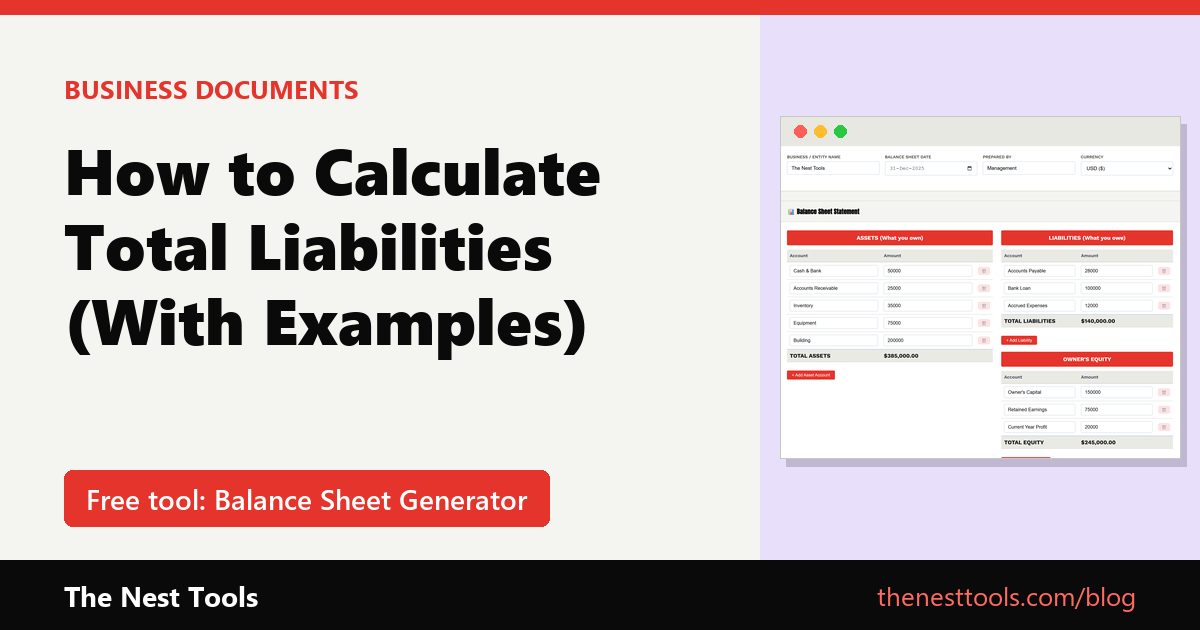
The free Balance Sheet Generator lists your assets and liabilities in categories, totals them automatically, shows equity or net worth, and exports a clean balance sheet as a PDF. It works for small businesses and personal finances, and nothing you enter is uploaded.
Useful Ratios Using Total Liabilities
| Ratio | Formula | What it shows |
|---|---|---|
| Debt ratio | Total liabilities ÷ total assets | How much of the assets is financed by debt (example: 110,000 ÷ 250,000 = 44%) |
| Debt-to-equity | Total liabilities ÷ equity | Borrowing compared with owner investment (0.79 in the example) |
| Current ratio | Current assets ÷ current liabilities | Ability to pay short-term bills; see current ratio and working capital |
Why Total Liabilities Matter
Lenders, investors and you yourself use total liabilities to judge financial health. A business with rising liabilities and flat assets is borrowing to stay afloat; a household whose total debt keeps falling is building net worth. Track the figure every quarter: the trend tells you more than any single number. Reducing high-interest liabilities first, such as credit cards, usually improves both cash flow and net worth fastest.
Frequently Asked Questions
How do you calculate total liabilities?
Add current liabilities (due within a year) and long-term liabilities, or subtract equity from total assets.
What is the formula for liabilities on a balance sheet?
Liabilities = assets − equity, from the accounting equation assets = liabilities + equity.
Is a mortgage a liability?
Yes. The outstanding balance is a liability; the home itself is an asset.
Are monthly expenses liabilities?
Only amounts already owed (an unpaid bill, for example). Future rent or utilities aren’t liabilities until they’re due.
What is the difference between liabilities and expenses?
A liability is an amount you owe at a point in time, such as a loan balance. An expense is a cost for a period, such as this month’s rent. An unpaid expense becomes a liability until you pay it.