Two percentages applied one after another trip people up in a specific way: the instinct is to add them, and that instinct is wrong.
The mistake
If something is 80% of a value, and you then want 25% of that, it’s tempting to think “25% and 80%, so roughly 105% or maybe I should subtract, 55%.” Neither is right. Percentages that apply one after another multiply, they don’t add or subtract.
The actual formula
To find a percentage of a percentage: convert both to decimals, multiply them, then convert back to a percentage.
Result = (Percentage 1 ÷ 100) × (Percentage 2 ÷ 100) × 100
So 25% of 80% is: (25 ÷ 100) × (80 ÷ 100) × 100 = 0.25 × 0.8 × 100 = 20%.
Where this actually shows up
This isn’t just a math-class exercise. A few real situations where percentages stack instead of add:
- Stacked discounts: 20% off, then an extra 10% off the already-discounted price, is not a 30% total discount. It’s 20% off, then 10% of the remaining 80%, which works out to 28% off the original price, not 30%.
- Tax on a discounted price: if an item is 15% off and then taxed at 8%, the tax applies to the discounted price, not the original, so the two percentages compound rather than simply adding to 23%.
- Pass rates across stages: if 80% of applicants pass round one, and 25% of those pass round two, the share who pass both isn’t 105% or 55%, it’s 20% of the original group, exactly the compounding math above.
The one-line takeaway
Whenever a percentage is applied to a result that’s already a percentage of something else, multiply the two decimal forms together. Adding them only works when both percentages are separately measuring a share of the exact same original whole, which stacked discounts, compounded tax, and multi-stage pass rates never are.
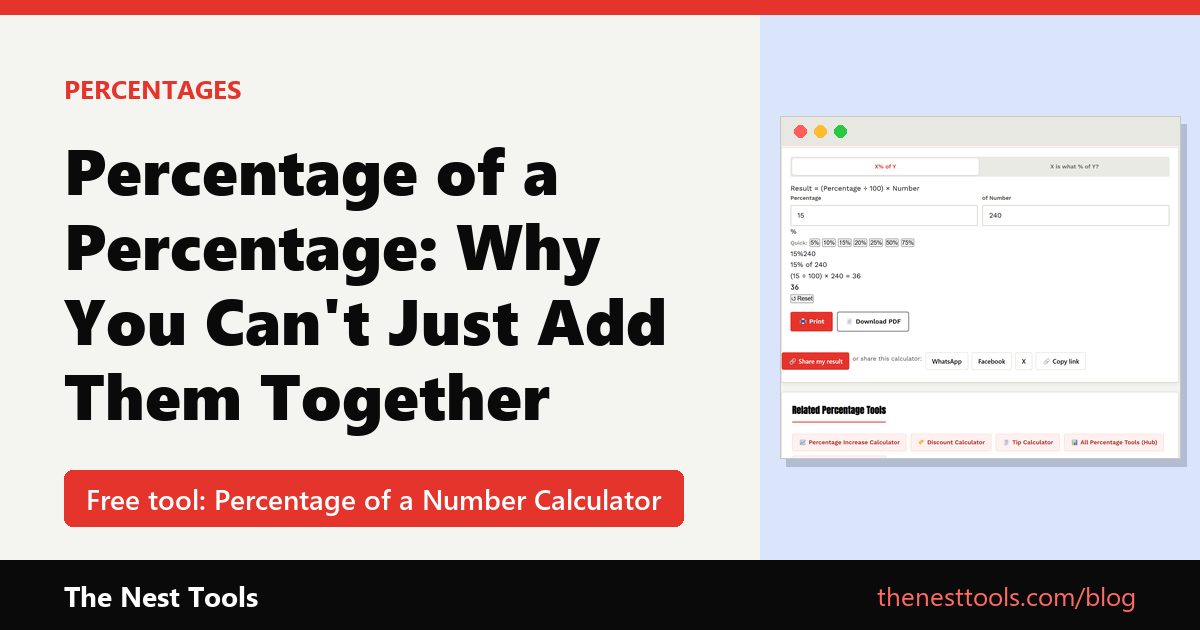
Our Percentage of a Number Calculator handles both a straightforward percentage of a value and a percentage of a percentage, so you don’t have to do the decimal conversion by hand.
Frequently Asked Questions
How do you calculate a percentage of a percentage?
Convert both to decimals, multiply them, and turn the result back into a percentage. For example, 25% of 80% = 0.25 × 0.8 = 0.20, or 20%.
Is 20% off plus an extra 10% off the same as 30% off?
No. The second discount applies to the already-reduced price, so the total is 1 − (0.8 × 0.9) = 28% off, not 30%.
When can you add percentages together?
Only when both percentages are shares of the same original whole, such as 20% of a budget on rent and 10% on food, which together make 30% of that budget.