A Systematic Investment Plan (SIP) means investing a fixed amount at regular intervals — usually monthly — instead of putting in one lump sum. The math behind how a SIP grows is a bit different from a single lump-sum investment, since every contribution has a different amount of time to grow.
Lump Sum vs. SIP
With a lump sum, your entire investment starts compounding from day one. With a SIP, each individual contribution starts its own compounding clock from the date it’s invested — your first month’s contribution has years longer to grow than your final month’s contribution.
The SIP Future Value Formula
FV = P × [(1 + r)n − 1] ÷ r × (1 + r)
- P = amount invested each period
- r = expected periodic rate of return
- n = total number of investment periods
This formula assumes a constant rate of return, which real markets don’t provide — actual SIP returns vary with market performance and are never guaranteed.
Why “Rupee-Cost Averaging” Gets Mentioned
Because you invest a fixed amount regularly regardless of price, you automatically buy more units when prices are lower and fewer units when prices are higher. Over time, this averages your purchase cost, which is one reason SIPs are often recommended for volatile, market-linked investments rather than trying to time the market with a single lump sum.
Why the Growth Curve Looks Slow, Then Fast
In the early years, a SIP’s growth looks close to linear — you’re mostly just accumulating your own contributions. As years pass, compounding on the earlier contributions starts to noticeably outpace new contributions, which is why long-term SIP growth curves tend to bend upward later rather than growing at a steady straight line.
Estimate Your SIP Growth
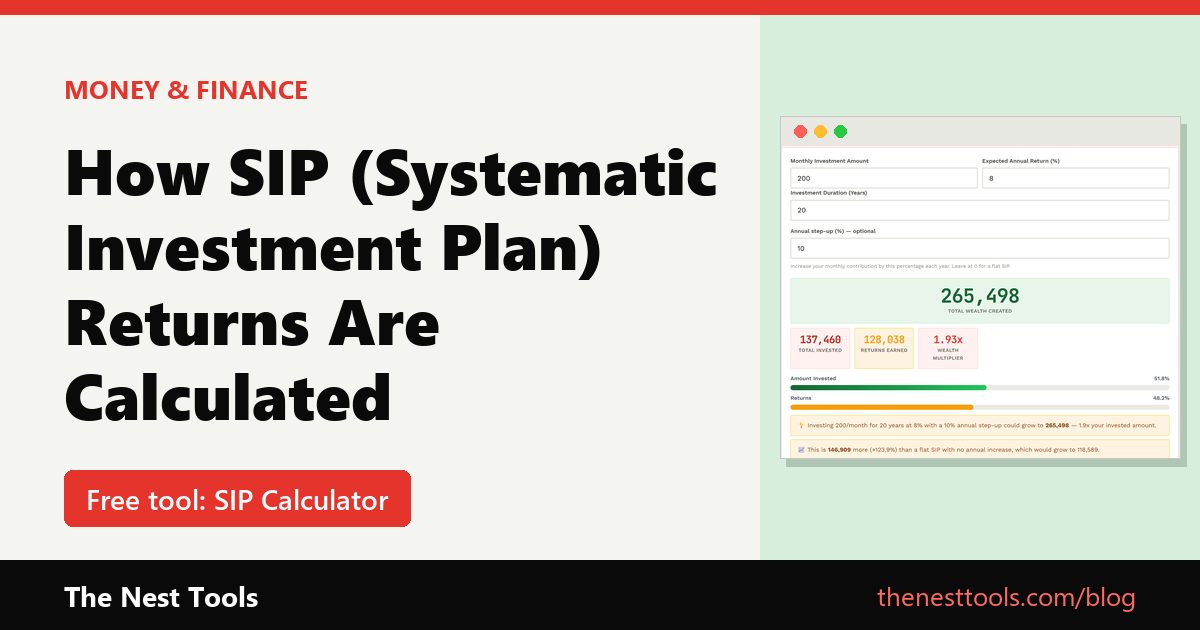
The Nest Tools’ SIP Calculator projects your investment’s estimated future value based on your monthly contribution, expected return rate, and time period — useful for planning, though actual market returns will vary.
Once you know your projected SIP growth, our Savings Goal Calculator can work backward from a target amount to tell you exactly how much you would need to invest each month to reach it.
Frequently Asked Questions
Are SIP returns guaranteed?
No. SIPs are typically used to invest in market-linked instruments (like mutual funds), so returns depend on market performance and are never guaranteed.
Is a SIP always better than a lump sum investment?
Not necessarily — it depends on market conditions and timing. SIPs are often chosen for discipline and reducing timing risk, not because they mathematically outperform lump sums in every scenario.