An estimate and a quote come before the work, an invoice asks for payment after it, and a receipt confirms you’ve been paid. An estimate is a rough, changeable guess at the cost; a quote is a firm price for a defined job; an invoice lists what was delivered and when payment is due; a receipt proves payment was received. Using the right one at each stage avoids disputes and makes your records match.
Below: a side-by-side comparison, what each document should include, and a simple example of all four for one job.
The Four Documents at a Glance
| Estimate | Quote | Invoice | Receipt | |
|---|---|---|---|---|
| When | Before the work | Before the work | After (or during) the work | After payment |
| Purpose | Give an idea of cost | Offer a fixed price | Request payment | Confirm payment |
| Price | Approximate, may change | Fixed for the stated scope | Exact amount owed | Exact amount paid |
| Who keeps it | Client | Both | Both, for records and tax | Client, as proof |
The usual order is estimate → quote → invoice → receipt, although many small jobs skip the estimate and go straight to a quote, and some businesses send a single “paid invoice” that doubles as a receipt.
Estimate
An estimate is your best guess when the scope isn’t fully known, for example a repair where you can’t see the damage until you start. Label it clearly as an estimate, give a range if you can, and say what could change the price. Because it’s approximate, an estimate generally isn’t treated as a promise to do the work at that price.
Quote (Quotation)
A quote is a fixed price for a clearly defined job. Include:
- A quote number and date, and how long the price is valid (for example 30 days)
- Exactly what’s included, and what isn’t
- The price, with tax shown separately if you charge it
- Payment terms you’ll use on the invoice, such as a deposit or Net 15
Once a client accepts a quote, it can form part of your agreement, so a change of scope should mean a new or revised quote. How binding it is depends on your local law and what you both agreed.
Invoice
An invoice requests payment for work done or goods supplied. A clear invoice includes:
- The word “Invoice”, a unique invoice number and the issue date
- Your name or business name and contact details, plus your tax number if you’re registered
- The client’s name and details, and any reference or purchase order number they gave you
- Each item or service with quantity, rate and amount
- Subtotal, any discount, tax and the total due
- The due date and payment terms, and how to pay (bank details or payment link)
Tax invoices have extra legal requirements in many countries, for example VAT or GST details, so check your local rules if you’re registered for sales tax.
Receipt
A receipt confirms payment. It should show the date paid, the amount, how it was paid, and what it was for, ideally referencing the invoice number. For an invoice paid in full, many businesses mark the invoice “Paid” and send it back; that works as a receipt as long as it shows the payment date and amount.
One Job, Four Documents: Example
- Estimate, 2 March: “Website redesign: about 1,200–1,600 depending on the number of pages.”
- Quote Q-014, 6 March: “8-page redesign, 2 rounds of revisions: 1,400. Valid 30 days. 50% deposit, balance Net 15.”
- Invoice INV-031, 28 March: “Balance for Q-014: 700. Due 12 April.” (The 700 deposit was invoiced separately on acceptance.)
- Receipt, 10 April: “Received 700 by bank transfer for INV-031. Paid in full.”
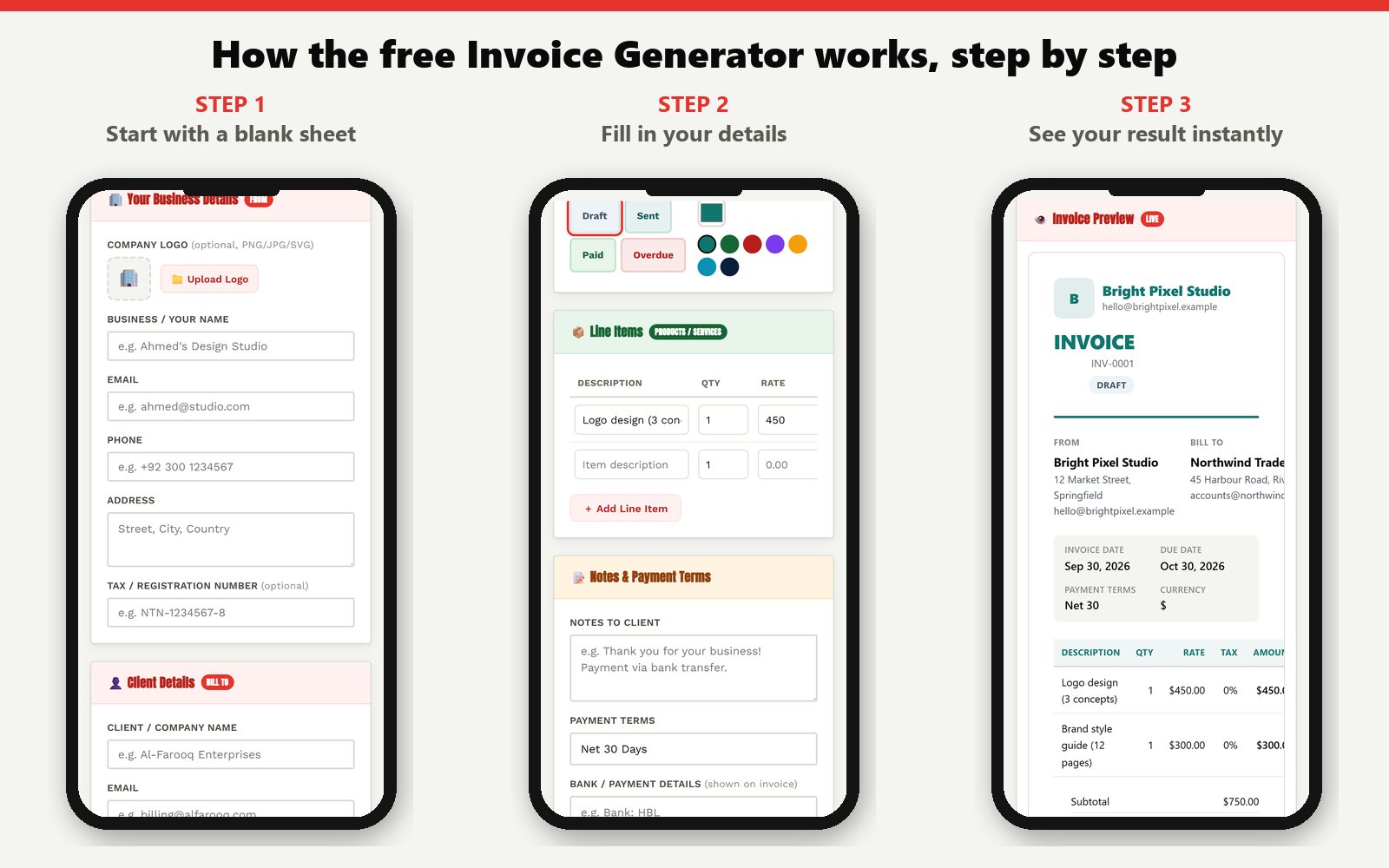
You can create the invoice in the free invoice generator: add your line items, set the status to Sent or Paid, download a PDF, or send your client a private link.
Frequently Asked Questions
What is the difference between a quote and an invoice?
A quote is sent before the work and offers a price for a defined job. An invoice is sent after the work, or at agreed stages, and asks for payment of an exact amount by a due date. A quote says what it will cost; an invoice says what is owed.
Is an invoice the same as a receipt?
No. An invoice asks for payment; a receipt confirms that payment was received. An invoice marked “Paid” with the payment date and amount can serve as a receipt, but an unpaid invoice is never proof of payment.
Is an estimate legally binding?
Generally not in the same way as an accepted quote, because it’s labelled as approximate. The details depend on your country and on what you and the client agreed, so describe clearly what the estimate covers and what could change it.
Do I need to send a quote before an invoice?
No, but it helps for anything beyond a small, simple job. Agreeing a quote first sets the price and scope in writing, which makes the invoice easier to approve and reduces disputes about what was included.
Create a professional invoice in minutes with the free invoice generator, and keep track of what you own and owe with the balance sheet generator.