“How to Write a Great Heading” or “How to write a great heading”? Both are correct. The first is title case, the second is sentence case, and which one you should use depends almost entirely on who you’re writing for. Academic papers usually want one, tech companies and newsrooms mostly use the other, and the worst option is mixing them on the same page.
Here’s the difference, what the major style guides say, and a simple way to decide for your own headings.
The Difference
Title case capitalizes the first letter of every major word. Short “minor” words (articles like a, an, the; conjunctions like and, but, or; and short prepositions like in, of, on, to) stay lowercase unless they’re the first or last word.
Example: The Complete Guide to Saving for a House
Sentence case treats the heading like a normal sentence: capitalize the first word and any proper nouns, and lowercase everything else.
Example: The complete guide to saving for a house in Canada
Proper nouns (names, places, brands, product names) keep their capitals in both styles, which is why “Canada” stays capitalized above.
What the Major Style Guides Say
| Style guide | Headings | Where it’s used |
|---|---|---|
| APA (7th edition) | Title case for paper headings; sentence case for article and book titles in reference lists | Psychology, social sciences, education |
| Chicago Manual of Style | Title case (“headline style”) for titles and headings | Publishing, history, the humanities |
| MLA | Title case for titles | Literature, languages |
| AP Stylebook | Sentence case for headlines (first word and proper nouns only) | News, PR, many corporate blogs |
| Google developer documentation style guide | Sentence case for titles and headings | Technical docs |
| Microsoft Style Guide | Sentence-style capitalization for headings and most UI text | Software, product copy |
| GOV.UK style guide | Sentence case | UK government content |
A useful rule of thumb from the pattern above: academic and traditional publishing lean title case; news, tech and government lean sentence case. There’s also a loose geographic split, with title-case headings more common in US publishing and sentence case more common elsewhere, though that’s a tendency rather than a rule.
Title Case Rules (the Parts People Get Wrong)
The small-word rules differ slightly between guides, but these hold almost everywhere:
- Always capitalize the first and last word, even if it’s a small word: “What Are You Waiting For?”
- Capitalize all verbs, including short ones. Is, Are, Be, Was and Go are verbs, so they’re capitalized: “Why Budgeting Is Hard.” This is the single most common title-case mistake.
- Capitalize nouns, pronouns, adjectives and adverbs, however short: “How It Works,” “So Far, So Good.”
- Lowercase articles and coordinating conjunctions in the middle: a, an, the, and, but, or, nor, for, yet, so.
- Prepositions are where guides disagree. Chicago lowercases all prepositions regardless of length; APA capitalizes any word of four letters or more (“Life With Kids”); AP capitalizes words of four letters or more in composition titles.
- Hyphenated words: most guides capitalize both parts of a hyphenated compound (“Long-Term Savings”), though Chicago has exceptions for prefixes.
Sentence Case Rules
Sentence case is simpler, which is a big part of its appeal:
- Capitalize the first word.
- Capitalize proper nouns and anything always written with capitals (NASA, iPhone, Excel).
- Capitalize the first word after a colon in a heading (Google’s and Microsoft’s guides both recommend this).
- Lowercase everything else.
Which Should You Use for Headings?
Follow the required style guide if there is one. A university paper in APA needs APA headings; a press release for a newsroom should follow AP.
For websites, apps and blogs, sentence case is usually the safer default. It’s easier to apply consistently across a team, it reads more naturally in long headings, and it’s what large tech style guides have standardized on. Long title-case headings can also look shouty and make it harder to spot proper nouns.
Title case still works well for short, formal headings such as book titles, product names, report titles and navigation labels, where a more formal look is the point.
Whatever you pick, be consistent. Readers notice a page that mixes the two styles far more than they notice which one you chose. Decide on one style for page titles and one for subheadings (they can differ), write it down, and apply it everywhere.
Converting Text Between Cases
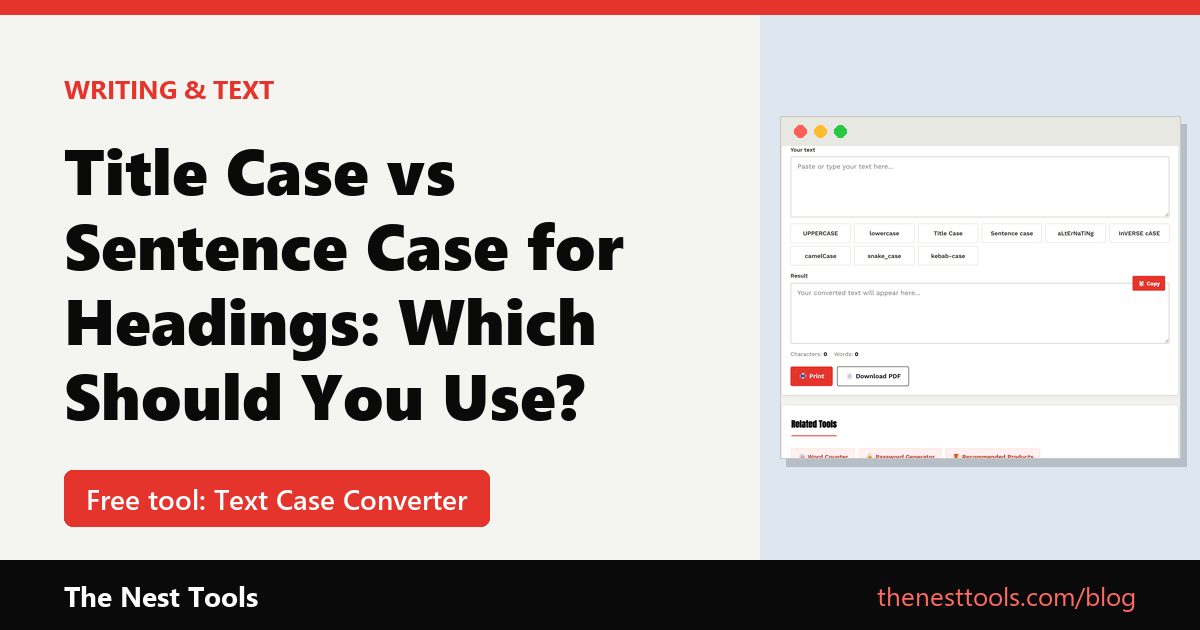
Retyping a list of headings to switch style is tedious and easy to get wrong. The Text Case Converter turns any text into Title Case, Sentence case, UPPERCASE, lowercase and developer formats like camelCase, snake_case and kebab-case. Its Title Case keeps common articles, conjunctions and short prepositions lowercase in the middle of a heading. Always give the result a quick read for proper nouns and brand names, which no automatic converter can know about.
Frequently Asked Questions
Is title case or sentence case more professional?
Neither is more professional by default. Title case looks more formal and traditional; sentence case looks more modern and conversational. Consistency matters more than which one you choose.
Does APA use title case or sentence case?
Both. APA 7th edition uses title case for headings within a paper and for the paper’s title, and sentence case for the titles of articles and books in the reference list.
Should “is” be capitalized in a title?
Yes. “Is” is a verb, and all major title-case styles capitalize verbs regardless of length.
Should blog post titles be in title case?
Either works. Many US blogs use title case for the post title and sentence case for subheadings; many tech and news sites use sentence case throughout. Pick one approach and keep it consistent across your site.
Switch a heading, a list or a whole document between cases in one click with the Text Case Converter.
Sources: Google developer documentation style guide; Microsoft Style Guide; APA Style; GOV.UK style guide.