Body Mass Index, or BMI, is usually the first number people look at when they want a quick read on whether their weight is in a healthy range. It’s simple to calculate, doesn’t require any special equipment, and has been used by doctors and health organizations for decades. But most people who search for it don’t actually know the formula behind their result — or what it means once they have it.
What Is BMI?
BMI is a ratio of your weight to the square of your height. It was never designed to measure body fat directly — it’s a screening tool that estimates whether your weight is proportionate to your height, based on population-level data.
The BMI Formula
Metric: BMI = weight (kg) ÷ height (m)²
Example: a person weighing 70 kg who is 1.75 m tall has a BMI of 70 ÷ (1.75 × 1.75) = 22.9
Imperial: BMI = (weight (lb) ÷ height (in)²) × 703
Example: a person weighing 154 lb at 68 inches tall has a BMI of (154 ÷ 4624) × 703 = 23.4
How to Do BMI on a Calculator (Step by Step)
You don’t need a special app. Any phone or desk calculator works, as long as you do the steps in the right order.
Metric (kilograms and centimetres)
- Convert your height to metres by dividing centimetres by 100. For example, 175 cm becomes 1.75 m.
- Enter your weight in kilograms:
70 - Divide by your height:
÷ 1.75(the screen shows 40) - Divide by your height again:
÷ 1.75(the screen shows 22.857…) - Round to one decimal place: your BMI is 22.9.
Dividing by the height twice is the same as dividing by height squared, and it avoids the most common mistake: squaring the height in your head and getting it wrong.
Imperial (pounds, feet and inches)
- Convert your height to inches only: feet × 12 + inches. For example, 5 ft 9 in = 5 × 12 + 9 = 69 inches.
- Enter your weight in pounds:
160 - Multiply by 703:
× 703(the screen shows 112,480) - Divide by your height in inches:
÷ 69(the screen shows 1,630.1…) - Divide by your height again:
÷ 69(the screen shows 23.62…) - Round to one decimal place: your BMI is 23.6.
Common Mistakes That Give a Wrong BMI
- Using centimetres instead of metres. 70 ÷ 175 ÷ 175 gives 0.0023, not 22.9.
- Treating 5 ft 9 in as 5.9 feet. Always convert to inches first (69 in), or to metres.
- Dividing by height only once. You’d get 40 instead of 22.9. BMI uses height squared.
- Forgetting the 703 in the imperial version, which gives a number around 0.03.
BMI Categories
Most health authorities use the following standard adult BMI ranges:
- Below 18.5 — Underweight
- 18.5 to 24.9 — Healthy weight
- 25 to 29.9 — Overweight
- 30 and above — Obese (WHO splits this into class I: 30–34.9, class II: 35–39.9, and class III: 40+)
These are the World Health Organization’s adult categories, the same for men and women. The WHO also recommends lower action points for many Asian populations, with increased risk from a BMI of 23 and high risk from 27.5, because the risk of type 2 diabetes and heart disease rises at lower BMIs in these groups.
Why BMI Isn’t the Whole Picture
BMI has real limitations. It doesn’t distinguish between muscle and fat, so a muscular athlete can show as “overweight” despite having very low body fat. It also doesn’t account for age, sex, or where fat is distributed on the body — two people with the same BMI can have very different health profiles. BMI is best used as a starting point for a conversation about health, not a final verdict.
Calculate Your BMI Instantly
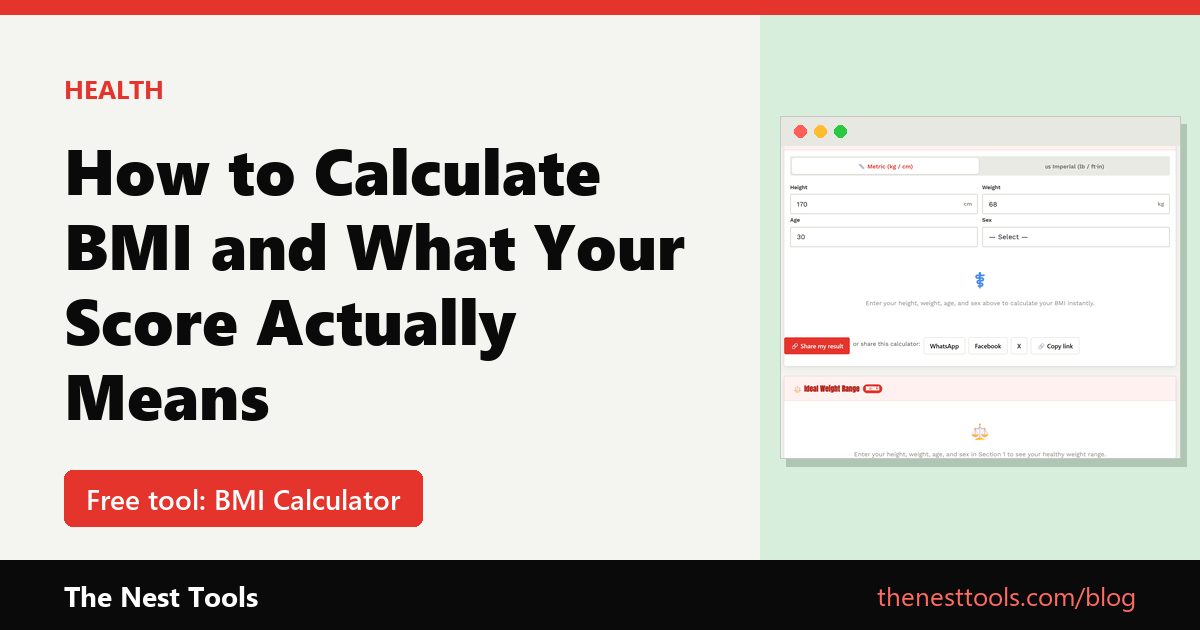
Instead of doing the math by hand, you can use The Nest Tools’ free BMI Calculator to get your score instantly, along with your healthy weight range, an estimated body fat range, and your daily calorie needs (TDEE) — all calculated in your browser with nothing sent to a server.
Frequently Asked Questions
How do I calculate BMI on my phone calculator?
In metric, type your weight in kg, divide by your height in metres, then divide by your height in metres again. In imperial, multiply your weight in pounds by 703, then divide by your height in inches twice. See the step-by-step examples above.
Why is my hand-calculated BMI different from a BMI calculator?
Almost always a unit slip: centimetres instead of metres, feet written as decimals (5.9 instead of 5 ft 9 in), or dividing by height only once. Re-check those three and the numbers will match.
Is BMI accurate for everyone?
No. It’s a useful general screening tool for most adults, but it’s less reliable for athletes, older adults, pregnant women, and children, who need different assessment methods.
What’s a “healthy” BMI to aim for?
Generally, a BMI between 18.5 and 24.9 is considered healthy for most adults, but your ideal range can depend on factors like muscle mass, frame size, and overall health.
Does BMI apply to children the same way?
No. Children and teens are assessed using age- and sex-specific BMI percentiles, not the fixed adult categories above.