The standard way to convert an annual salary to an hourly rate assumes you get paid for all 52 weeks of the year. If part of your time off is unpaid, that assumption quietly overstates your real hourly rate.
The standard formula
Annual Salary ÷ (Hours per Week × Weeks per Year)
For a $52,000 salary at 40 hours a week, 52 weeks a year: $52,000 ÷ (40 × 52) = $52,000 ÷ 2,080 = $25.00/hour.
Why unpaid leave changes this
That $25.00/hour figure only holds if you’re actually paid for all 2,080 of those hours. If you take unpaid leave, say 2 weeks unpaid on top of your normal paid vacation, you’re only actually being paid across 50 weeks, not 52, even though your “annual salary” figure is the same number on paper.
To find your real effective hourly rate, use the weeks you’re actually paid for instead of the full 52:
Annual Salary ÷ (Hours per Week × Actual Paid Weeks)
Same $52,000 salary, but only 50 paid weeks: $52,000 ÷ (40 × 50) = $52,000 ÷ 2,000 = $26.00/hour.
Why the rate goes up, not down
This surprises people at first, the hourly rate went up, not down, even though you’re taking unpaid time off. That’s because the same total salary is being divided across fewer actual working hours. Your take-home pay for the year is still lower with unpaid leave (you’re not getting paid for those extra 2 weeks), but the rate per hour you actually work goes up slightly, since the fixed salary is now spread across a smaller number of paid hours.
This matters most if you’re comparing a salaried offer against an hourly one, or figuring out what an hour of unpaid leave is actually costing you: at $26.00/hour effective rate and 80 unpaid hours (2 weeks), that unpaid leave costs roughly $2,080 in foregone pay, not the $2,000 you’d estimate using the naive $25.00/hour figure.
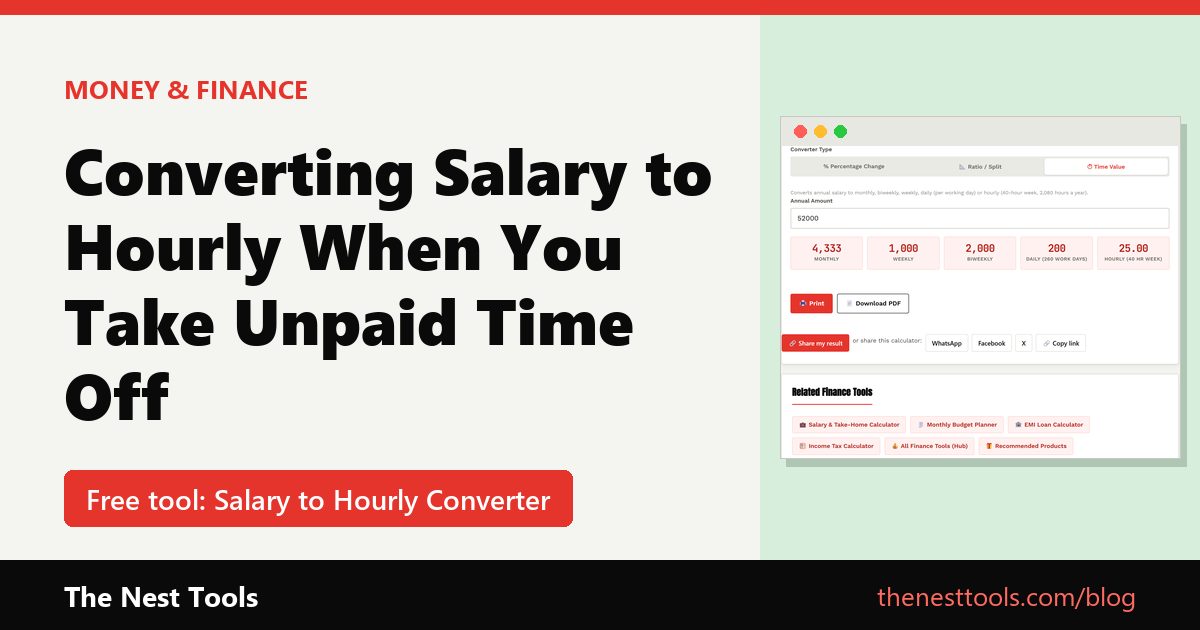
Our Finance Converter converts an annual figure into hourly, daily, weekly, and monthly amounts. Enter the amount you’re actually paid over the year (your salary minus any unpaid leave) instead of your nominal salary figure, and the hourly result it gives you is your real effective rate rather than the naive one.
Frequently Asked Questions
How many work hours are in a year?
A standard full-time year is 2,080 hours: 40 hours a week for 52 weeks. That’s the figure most salary-to-hourly conversions use.
How do I convert my salary to an hourly rate with unpaid leave?
Divide your salary by the hours you’re actually paid for: hours per week × paid weeks. For example, $52,000 ÷ (40 × 50) = $26.00 an hour.
Does unpaid leave lower my hourly rate?
No. It lowers your total pay for the year, but your effective rate per paid hour goes up slightly, because the same salary covers fewer paid hours.