Saving $10,000 takes 20 months at $500 a month, a year at about $833 a month, or a little over four years at $200 a month. Interest shortens the longer timelines noticeably and the short ones barely at all. The same math works for £10,000 or €10,000; just swap the currency sign.
Here’s a table for every common monthly amount, how much interest actually helps, and practical ways to hit the goal sooner.
How Long to Save $10,000, by Monthly Amount
| Saved per month | No interest | With 4% annual interest |
|---|---|---|
| $100 | 100 months (8 yrs 4 mo) | 87 months (7 yrs 3 mo) |
| $200 | 50 months (4 yrs 2 mo) | 47 months (3 yrs 11 mo) |
| $250 | 40 months (3 yrs 4 mo) | 38 months |
| $300 | 34 months | 32 months |
| $400 | 25 months | 25 months |
| $500 | 20 months | 20 months |
| $750 | 14 months | 14 months |
| $1,000 | 10 months | 10 months |
The 4% column assumes deposits at the end of each month and interest compounding monthly. It’s an illustrative rate; check what your own savings account actually pays.
How Much to Save Each Month to Reach $10,000
| Deadline | No interest | With 4% annual interest |
|---|---|---|
| 6 months | $1,667 | $1,653 |
| 1 year | $833 | $818 |
| 18 months | $556 | $540 |
| 2 years | $417 | $401 |
| 3 years | $278 | $262 |
| 5 years | $167 | $151 |
The Formulas (If You Want to Check the Math)
Without interest: months = goal ÷ monthly saving. $10,000 ÷ $400 = 25 months.
With interest, where i is the monthly rate (annual rate ÷ 12) and P is your monthly deposit:
- Months needed = ln(goal × i ÷ P + 1) ÷ ln(1 + i)
- Monthly deposit needed in n months = goal × i ÷ ((1 + i)n − 1)
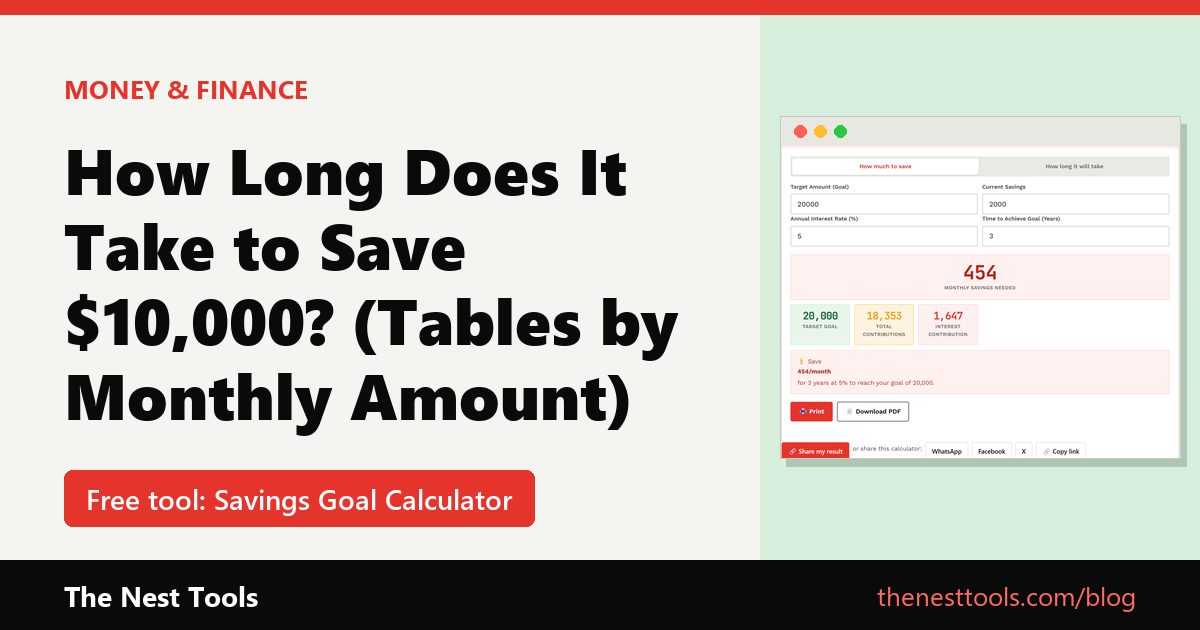
The Savings Goal Calculator runs both directions for you. Choose “How much to save” to get a monthly amount for a deadline, or “How long it will take” to get a timeline for a fixed monthly amount. It also lets you enter what you’ve already saved and an interest rate.
Does Interest Really Help?
On short goals, not much. Over 12 months at 4%, interest saves you only about $15 a month compared with saving the full amount yourself. Over five years it cuts the monthly amount from $167 to about $151, roughly a 10% discount.
That doesn’t make the account choice unimportant. Money sitting in a checking account earning nothing is still money that’s easy to spend. A separate savings account, ideally one that pays a competitive rate, does two jobs: it earns a little, and it keeps the goal out of sight. For a 1–3 year goal, keep the money somewhere safe and accessible rather than in stocks, since a market drop right before you need it can set you back months.
Ways to Reach $10,000 Faster
- Automate the transfer for payday. Money that moves before you see it doesn’t get spent.
- Save windfalls. Tax refunds, bonuses and cash gifts can take months off the timeline in one go. A single $1,500 refund cuts a $300-a-month plan from 34 months to 29.
- Cancel one or two forgotten subscriptions and redirect that amount. Our Subscription Cost Calculator shows what they really cost each year.
- Increase the amount after every raise. Put half of any pay rise straight into the goal.
- Use a budget split. A plan like 50/30/20 (needs/wants/savings) turns “save more” into a specific number. Our Budget Planner can help you find it.
- Track progress visibly. Seeing the balance climb is one of the most reliable motivators.
What $10,000 Is Often For
Ten thousand is a popular target because it’s big enough to matter: a solid emergency fund for many single households, a used-car fund, a deposit toward a rental move, or the first milestone toward a house deposit. If yours is an emergency fund, a common rule of thumb is three to six months of essential expenses, so work out your own monthly essentials and set the goal from that rather than from a round number.
Frequently Asked Questions
How long does it take to save $10,000?
It depends on your monthly saving: 10 months at $1,000, 20 months at $500, 34 months at $300 and about 50 months (just over four years) at $200, before interest.
How much do I need to save a month to have $10,000 in a year?
About $833 a month without interest, or around $818 a month if your savings earn 4% a year.
Is it realistic to save $10,000 in 6 months?
It takes about $1,667 a month, so it’s realistic mainly for people with a high income, low fixed costs or a windfall to add. For most budgets, 12–24 months is a more sustainable target.
Where should I keep money I’m saving for a goal?
For goals under a few years away, a separate savings account that pays interest and lets you withdraw when needed is usually the right fit. It keeps the money safe and separate from everyday spending.
Set your own target and deadline in the Savings Goal Calculator to see exactly what to save each month.